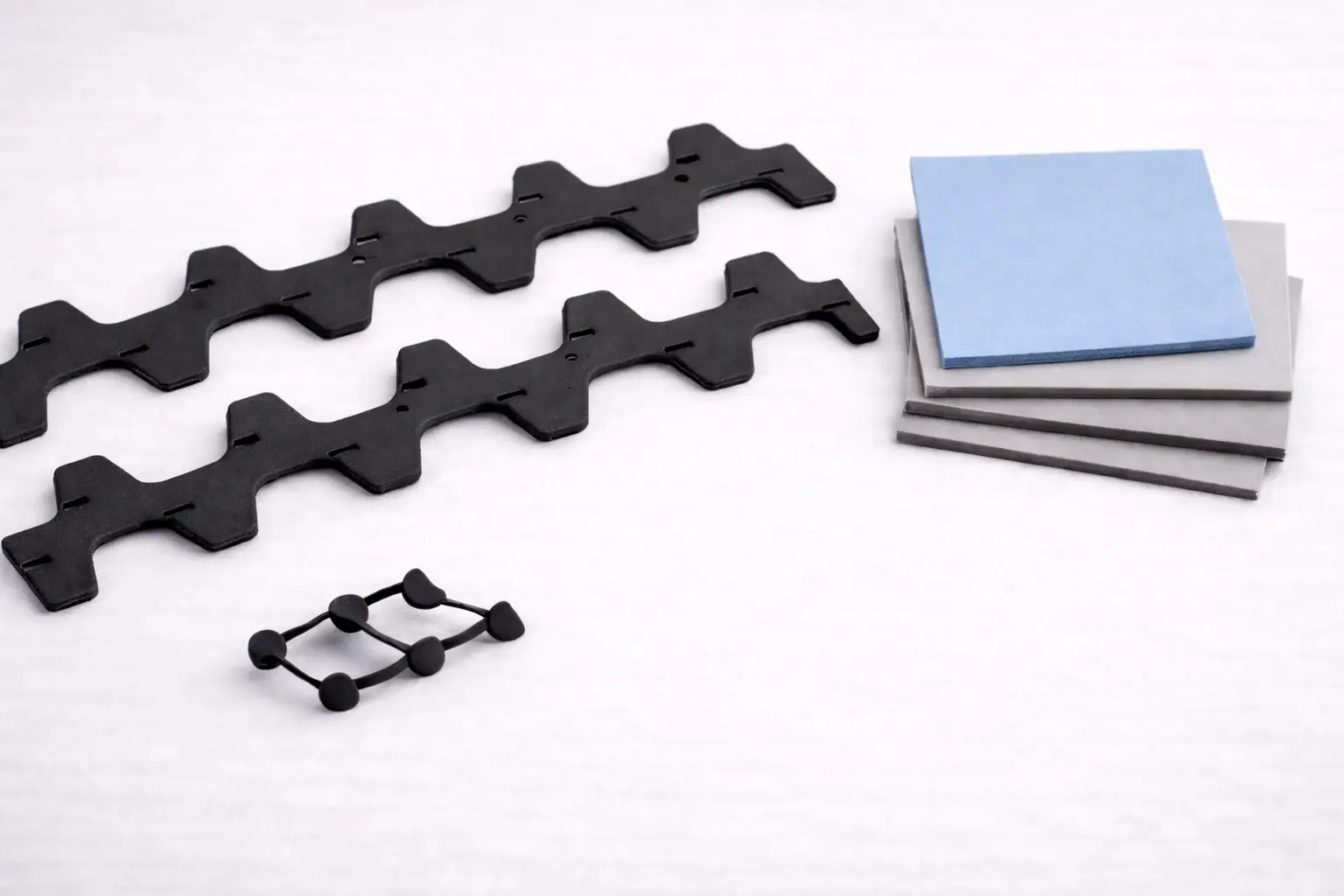
Thermal Conductive Pads
ARPL manufactures silicone thermal conductive pads and gap fillers — soft, compressible thermal interface materials (TIM) that transfer heat from battery cells, power modules, and electronic components to heat sinks and cold plates. We offer thermal conductivity from 1 to 8 W/mK in thicknesses from 0.3 mm to 10 mm, die-cut to custom shapes for EV battery packs, power electronics, BMS, LED modules, and industrial thermal management applications.
Thermal Pad Types
Silicone Thermal Conductive Pads for Heat Dissipation & Thermal Management
Effective thermal management is critical in EV batteries, power electronics, and high-density electronic assemblies. Component surfaces are never perfectly flat — microscopic air gaps between mating surfaces create high thermal resistance that limits heat transfer. Thermal conductive pads fill these gaps with a soft, compressible silicone material loaded with ceramic or metallic fillers, creating a continuous thermal path from heat source to heat sink.
ARPL manufactures silicone thermal conductive pads using compression molding and calendering processes with controlled filler loading to achieve consistent thermal conductivity across the entire pad area. Our pads combine efficient heat transfer with electrical insulation, vibration damping, and mechanical compliance — enabling them to accommodate tolerance stack-ups and surface irregularities without damaging sensitive components.
Products We Manufacture
- Thermal gap filler pads — soft, highly compressible pads that fill gaps between battery cells and cold plates or between components and heat sinks with minimal compression force
- Thermally conductive shields — firmer pads with fiberglass reinforcement for structural support in thermal barrier applications between battery modules
- Insulating thermal pads — pads combining thermal conductivity with high dielectric strength for applications requiring both heat transfer and electrical isolation
- Conductive silicone foam — lightweight thermally conductive foam for applications requiring both thermal management and cushioning with low density
- Adhesive-backed thermal pads — thermal pads with PSA on one or both sides for peel-and-stick assembly without mechanical fasteners
- Custom die-cut TIM parts — precision die-cut thermal pads in any shape with cutouts, holes, and alignment features per customer drawings
Why Choose ARPL for Thermal Conductive Pads
- ISO 9001:2015 certified — controlled manufacturing with thermal conductivity testing and dimensional inspection
- Wide conductivity range — 1 to 8 W/mK with ceramic and hybrid filler systems for different performance requirements
- Precision die-cutting — flatbed and rotary die-cutting for complex shapes with tight tolerances
- UL 94 V-0 options — flame retardant thermal pads for EV battery and safety-critical applications
- Global supply — exporting to USA, Germany, UK, Japan, South Korea, UAE and 15+ countries
- 30+ years experience — established 1993, serving automotive OEMs and Tier-1 suppliers
Thermal Pad Specifications & Capabilities
ARPL formulates thermal conductive silicone compounds with ceramic fillers (alumina, boron nitride, aluminum nitride) to achieve the right balance of thermal conductivity, softness, compression force, and dielectric strength for your specific application.
Key Performance Parameters
- Thermal conductivity: 1 to 8 W/mK — standard grades at 1, 1.5, 2, 3, 5, and 8 W/mK with custom formulations available
- Thickness: 0.3 mm to 10 mm — selected based on gap tolerance and thermal resistance budget
- Hardness: 10 to 60 Shore OO — ultra-soft to medium-soft for minimal compression force on battery cells
- Temperature range: -55°C to +200°C — silicone base ensures stable performance across extreme temperatures
- Dielectric strength: 10 to 25 kV/mm — electrical insulation while conducting heat
- Compression: 10-50% at 10-100 kPa — low force conformability for sensitive components
- Flame rating: UL 94 V-0 — available for battery and safety-critical applications
Filler Technologies
- Alumina (Al₂O₃) — most common ceramic filler, cost-effective 1-3 W/mK range with good electrical insulation
- Boron Nitride (BN) — premium filler for 3-6 W/mK with excellent dielectric properties and low abrasion
- Aluminum Nitride (AlN) — high-performance filler for 5-8 W/mK applications requiring maximum thermal transfer
- Hybrid fillers — blended filler systems optimizing conductivity, cost, and mechanical properties
Thermal Pad Grade Comparison
| Grade | Conductivity | Thickness | Hardness | Flame Rating | Typical Application |
|---|---|---|---|---|---|
| TCP-1.0 | 1.0 W/mK | 0.5-10 mm | 15 Shore OO | V-0 | General electronics, LED modules |
| TCP-1.5 | 1.5 W/mK | 0.5-8 mm | 20 Shore OO | V-0 | BMS, power supplies, ADAS modules |
| TCP-2.0 | 2.0 W/mK | 0.5-5 mm | 25 Shore OO | V-0 | EV battery cell-to-cold plate |
| TCP-3.0 | 3.0 W/mK | 0.3-5 mm | 30 Shore OO | V-0 | Power modules, inverters, OBC |
| TCP-5.0 | 5.0 W/mK | 0.3-3 mm | 40 Shore OO | V-0 | High-power IGBT, motor controllers |
| TCP-8.0 | 8.0 W/mK | 0.3-2 mm | 55 Shore OO | V-0 | Premium EV applications, 5G base stations |
Note: Properties are typical values and may vary with thickness, compression, and test conditions. Contact our thermal team for detailed datasheets and application-specific recommendations.
Thermal Conductive Pad Applications
ARPL's thermal conductive pads serve applications across EV battery systems, power electronics, consumer electronics, LED lighting, and telecom infrastructure where efficient heat dissipation and thermal uniformity are critical for performance and reliability.
EV Battery Packs & Modules
Thermal pads are the primary thermal interface between battery cells and the liquid cold plate in EV battery packs. They fill the gap between cell bottom surfaces and the cooling plate, transferring heat generated during charging and discharging to the cooling system. ARPL supplies die-cut thermal pads matched to prismatic, cylindrical, and pouch cell geometries with low compression force to prevent cell deformation and UL 94 V-0 flame retardancy for safety compliance.
Power Electronics & Inverters
IGBT modules, MOSFETs, DC-DC converters, onboard chargers (OBC), and motor controllers generate concentrated heat that must be transferred to heat sinks or liquid cold plates. ARPL's higher conductivity pads (3-8 W/mK) provide the thermal performance needed for power electronics while maintaining electrical insulation between high-voltage components and grounded heat sinks.
Battery Management Systems (BMS)
BMS control boards generate heat from continuous monitoring and balancing operations. Thermal pads between BMS PCBs and enclosure walls or dedicated heat sinks maintain stable operating temperatures for accurate voltage and temperature measurement. ARPL supplies thin, soft thermal pads (0.3-2 mm) for BMS applications with minimal compression force on sensitive electronic components.
LED Lighting & Consumer Electronics
LED modules, display panels, processors, and wireless charging systems require thermal pads for heat dissipation to aluminum housings or heat sinks. ARPL supplies cost-effective 1-2 W/mK thermal pads die-cut to any shape for high-volume consumer electronics and LED lighting applications with consistent quality.
Telecom & 5G Infrastructure
5G base stations, communication modules, and network equipment generate significant heat in compact enclosures. ARPL's high-conductivity thermal pads (5-8 W/mK) transfer heat from RF amplifiers and processors to finned heat sinks and enclosure surfaces, supporting reliable operation in outdoor and temperature-extreme environments.
Global Export Markets
ARPL exports thermal conductive pads from India to OEMs and Tier-1 suppliers in the USA, Germany, UK, France, Italy, Japan, South Korea, Taiwan, UAE, Saudi Arabia, Turkey, Canada, Mexico, and Sweden. All exports comply with REACH, RoHS, and destination country regulations.
Request a Quote
Get a custom quote for your thermal conductive pad requirements
Related Products

Frequently Asked Questions
Find answers to common questions about thermal conductive pads
Thermal conductive pads are soft, compressible silicone sheets filled with thermally conductive ceramic particles (alumina, boron nitride, or aluminum nitride). They serve as thermal interface materials (TIM) that fill air gaps between heat-generating components and heat sinks or cold plates, creating a low-resistance thermal path for efficient heat dissipation in EV batteries, power electronics, and electronic assemblies.
ARPL offers silicone thermal conductive pads from 1 W/mK to 8 W/mK in standard grades (1.0, 1.5, 2.0, 3.0, 5.0, 8.0 W/mK). Higher conductivity grades use premium boron nitride and aluminum nitride fillers for demanding EV battery and power electronics applications. Custom conductivity formulations are available on request.
Yes. ARPL supplies die-cut thermal conductive pads for EV battery cell-to-cold plate interfaces, module-level thermal management, BMS heat dissipation, and inverter/OBC cooling applications. Pads are available with UL 94 V-0 flame retardancy, low compression force for cell protection, and custom shapes for prismatic, cylindrical, and pouch cell geometries.
Pad thickness should match the gap between the heat source and heat sink at assembly, accounting for tolerance stack-up. Thinner pads (0.3-1 mm) minimize thermal resistance but require tighter tolerances. Thicker pads (2-10 mm) accommodate larger gaps and tolerance variation but increase thermal resistance. ARPL's thermal team can help optimize thickness based on your gap analysis and thermal resistance budget.
Yes. ARPL's silicone thermal pads provide dielectric strength of 10 to 25 kV/mm depending on grade and thickness, offering electrical insulation while efficiently conducting heat. This dual function is essential in EV battery and power electronics applications where components must be thermally connected but electrically isolated from grounded heat sinks.
Yes. ARPL offers precision flatbed and rotary die-cutting of thermal pads to any shape from 2D drawings, CAD files, or physical samples. Die-cuts can include holes, cutouts, alignment notches, and registration marks for automated pick-and-place assembly.
Please share: required thermal conductivity (W/mK), pad dimensions and thickness, die-cut shape (drawing or sample), application type (battery, electronics, LED), heat source and heat sink materials, any flame retardancy or dielectric requirements, adhesive backing needed (single/double-sided), delivery format (individual die-cuts or sheets), and annual volume estimate.
Yes. ARPL exports thermal conductive pads globally to USA, Germany, UK, France, Italy, Japan, South Korea, Taiwan, UAE, Saudi Arabia, Turkey, Canada, Mexico, Sweden, and Netherlands. All exports comply with REACH, RoHS, and destination country regulations.