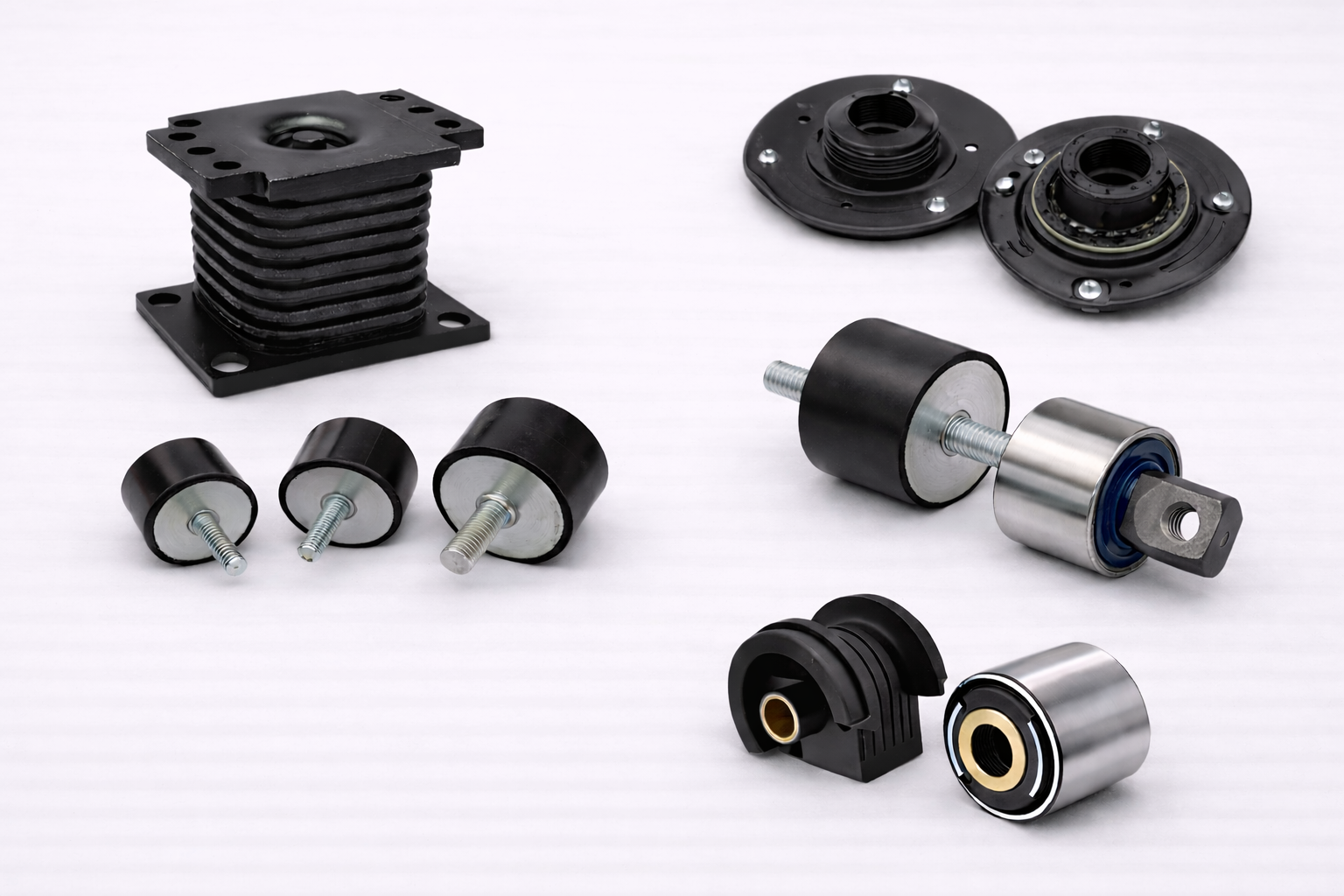
Rubber to Metal Bonded Components Manufacturer - Anti-Vibration Mounts, Engine Mounts & Bushings
ARPL manufactures rubber-to-metal bonded components for automotive, commercial vehicle, and industrial NVH applications. We chemically bond rubber to steel, aluminum, and brass during vulcanization to produce components that isolate vibration, absorb shock, and reduce noise. ISO 9001:2015 certified manufacturing at IMT Manesar, Haryana since 1993.
Rubber-to-Metal Bonding for Automotive & Industrial NVH
Rubber-to-metal bonding creates a permanent chemical bond between an elastomer and a metal substrate during vulcanization. The metal is grit-blasted, primed, and coated with a topcoat adhesive. During molding, the rubber cures and bonds to the metal simultaneously — producing an integrated component where the rubber and metal act as a single unit that will never separate in service.
ARPL has manufactured rubber-to-metal bonded NVH components since 1993 at IMT Manesar, Haryana, serving automotive OEMs and Tier-1 suppliers with consistent quality under ISO 9001:2015 certification. We operate compression, transfer, and injection molding presses for parts from 10g to 25kg, with in-house CNC tooling, metal preparation, and adhesion testing.
Bonding Process & Material Capabilities
ARPL's rubber-to-metal bonding achieves bond strengths exceeding the tear strength of the rubber — the rubber tears before the bond fails, confirmed by destructive peel testing on every production lot.
The Bonding Process
- Metal preparation — degreasing, grit-blasting, phosphate coating for corrosion protection and adhesion
- Primer application — phenolic resin-based primer creates the chemical bridge between metal and adhesive
- Topcoat application — rubber-specific adhesive topcoat formulated for the target elastomer
- Molding & vulcanization — rubber cures and bonds simultaneously under controlled temperature and pressure
- Inspection & testing — dimensional checks, hardness testing, and destructive adhesion testing (peel/tear) per lot
Rubber Compounds
- Natural Rubber / NR (-45°C to +80°C) — highest resilience and fatigue life. Preferred for engine mounts, bushings, and suspension components.
- EPDM (-50°C to +150°C) — excellent weather, ozone, and aging resistance for exterior-exposed components.
- Neoprene / CR (-35°C to +120°C) — moderate oil resistance and flame retardancy for industrial applications.
- Nitrile / NBR (-30°C to +120°C) — excellent oil and fuel resistance for engine-area components.
- Silicone / VMQ (-60°C to +200°C) — widest temperature range for exhaust and high-temp applications.
- Polyurethane / PU (-30°C to +80°C) — highest load capacity and abrasion resistance for heavy duty parts.
Metal Substrates
Mild Steel (zinc/phosphate plated), Stainless Steel, Aluminum, and Brass — prepared with grit blasting, degreasing, and chemical coating before primer and topcoat application.
Compound Comparison
| Compound | Temp. Range | Resilience | Oil Resistance | Weather | Typical Application |
|---|---|---|---|---|---|
| NR | -45 to +80°C | Excellent | Poor | Fair | Engine mounts, bushings, strut mounts |
| EPDM | -50 to +150°C | Good | Poor | Excellent | Exterior mounts, weather-exposed parts |
| CR | -35 to +120°C | Good | Moderate | Good | Industrial mounts, oil-exposed parts |
| NBR | -30 to +120°C | Fair | Excellent | Poor | Engine-area mounts, fuel system parts |
| VMQ | -60 to +200°C | Fair | Poor | Excellent | Exhaust mounts, high-temp anti vibration mounts |
| PU | -30 to +80°C | Fair | Good | Fair | Heavy duty bushings, high-load mounts |
Industries We Serve
ARPL's rubber-to-metal bonded components serve critical NVH and structural functions across automotive, commercial vehicle, construction, industrial, and railway sectors.
Passenger Vehicles
Strut mounts, engine and transmission mounts, control arm bushings, stabilizer bar bushings, and exhaust hangers for passenger cars and SUVs. Supplied to automotive OEMs and Tier-1 suppliers across India and globally.
Commercial Vehicles & Trucks
Torque rods, cab mounts, engine mounts, suspension bushings, V-rods, and stabilizer bar links for trucks, buses, and LCVs. Designed for 500,000+ km service life with high fatigue resistance and low compression set.
Construction & Earthmoving
Large rubber-metal mounts, boom bushings, track adjuster cushions, and cabin isolation mounts for excavators, loaders, dozers, and cranes in high-durometer NR and PU compounds.
Industrial Machinery & Power Generation
Cylindrical, conical, and sandwich-type anti vibration mounts for compressors, pumps, generators, HVAC systems, and production machinery from 1 kg to 500 kg load per mount.
Global Export Markets
ARPL exports rubber-to-metal bonded components from Manesar, Haryana to OEMs and Tier-1 suppliers in the USA, Germany, UK, France, Italy, Japan, South Korea, Taiwan, UAE, Saudi Arabia, Turkey, Canada, Mexico, and Sweden.
Request a Quote
Get a custom quote for your rubber-to-metal bonded component requirements
Related Products

Frequently Asked Questions
Find answers to common questions about rubber-to-metal bonded components
Rubber-to-metal bonding is a manufacturing process where rubber is permanently bonded to a metal insert during vulcanization using a two-layer adhesive system (primer + topcoat). The result is a single integrated component where the rubber and metal cannot be separated — the rubber will tear before the bond fails. This process is used to make engine mounts, bushings, strut mounts, anti vibration mounts, and other NVH components for automotive and industrial applications.
ARPL manufactures strut mounts, engine and transmission mounts, suspension bushings, anti vibration mounts, torque rods, and heavy duty rubber-metal components at our facility in IMT Manesar, Gurugram, Haryana. These parts serve automotive OEMs, commercial vehicle manufacturers, construction equipment, and industrial machinery sectors.
ARPL uses natural rubber (NR) for dynamic performance, EPDM for weather resistance, neoprene (CR) for oil resistance, nitrile (NBR) for fuel exposure, silicone (VMQ) for extreme temperatures (-60°C to +200°C), and polyurethane (PU) for high load capacity. Compound selection is based on operating environment, temperature, chemical exposure, and performance requirements.
ARPL bonds rubber to mild steel (most common for automotive), stainless steel, aluminum, and brass. Metal inserts are prepared in-house through grit blasting, degreasing, and phosphate coating before primer and topcoat adhesive application.
Every production lot undergoes destructive adhesion testing (peel and tear tests). The acceptance criterion is "R" failure mode — the rubber must tear before the bond fails. Additional quality checks include hardness testing, dimensional verification, and visual inspection under ISO 9001:2015 procedures.
ARPL supplies rubber-to-metal bonded components to leading automotive OEMs and Tier-1 suppliers. We serve customers across automotive hubs in Delhi NCR, Pune, Chennai, Bengaluru, and globally.
Please share: part drawing or sample, rubber compound preference (NR, EPDM, CR, NBR, etc.), metal substrate and surface finish, hardness requirement (Shore A), operating temperature range, load and stiffness specifications, annual volume, and any specific testing or certification requirements.
Yes. ARPL exports rubber-to-metal bonded components from Manesar, Haryana to OEMs and Tier-1 suppliers in USA, Germany, UK, France, Italy, Japan, South Korea, Taiwan, UAE, Saudi Arabia, Turkey, Canada, Mexico, Sweden, and Netherlands.