In modern automotive engineering, rubber grommets serve as critical protective and sealing components that safeguard electrical wiring, cables, and hoses from mechanical damage, environmental contamination, and vibration-induced wear. These seemingly simple components play a vital role in vehicle reliability, preventing costly electrical failures and ensuring long-term durability of automotive systems.
As vehicles incorporate increasingly complex electrical architectures—from conventional internal combustion engines to advanced electric vehicles—the demand for high-performance automotive grommets that meet stringent OEM specifications has never been greater. This comprehensive guide explores the materials, types, manufacturing processes, and quality standards that define excellence in automotive grommet production.
Key Takeaway
Automotive grommets are essential protective components that prevent wire abrasion, seal against moisture and dust, reduce vibration transmission, and provide strain relief for electrical connections passing through vehicle body panels and structural components.
What Are Rubber Grommets and Why Are They Essential in Automotive Applications?
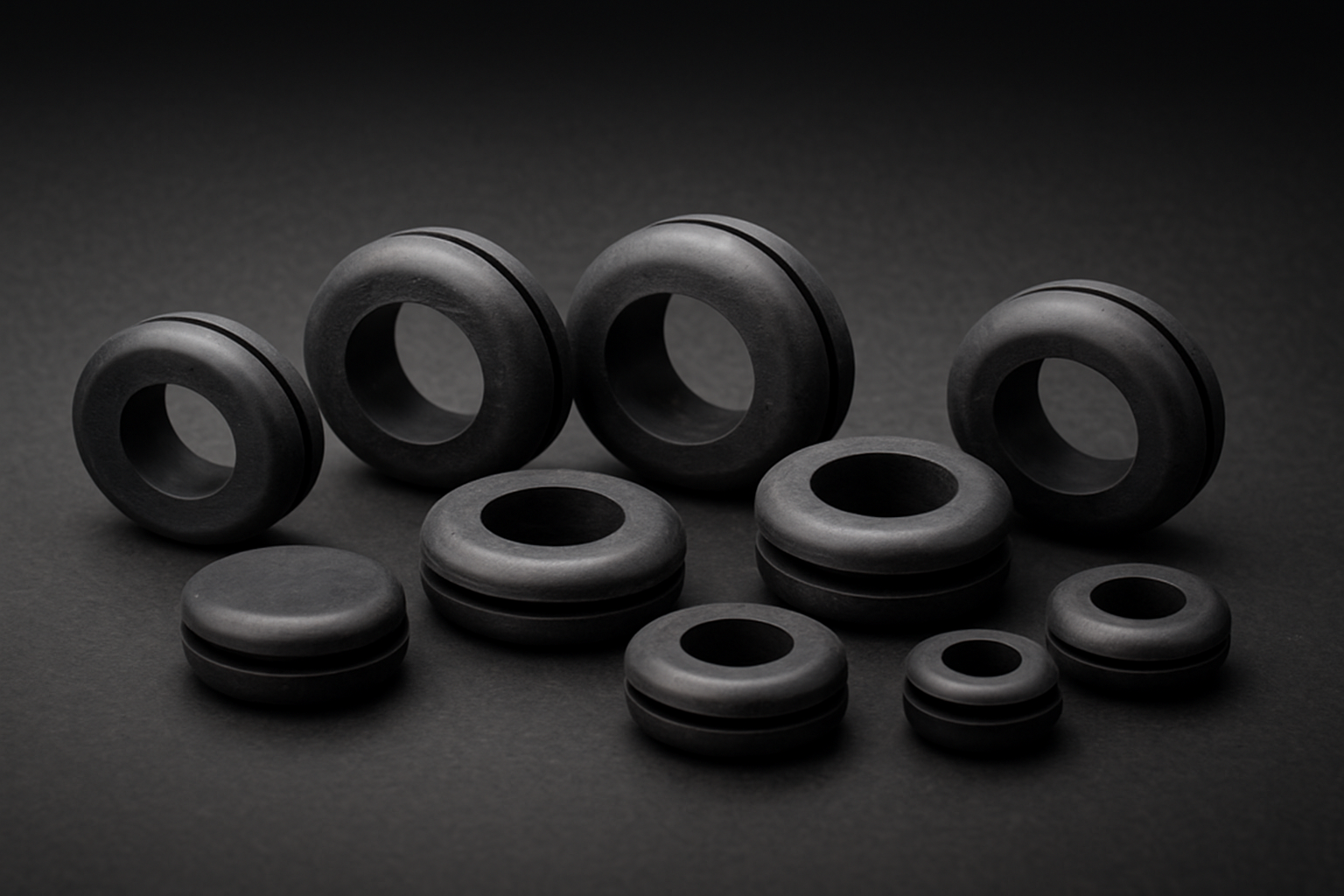
Rubber grommets are ring-shaped or tubular sealing components designed to protect wires, cables, and hoses as they pass through panels, bulkheads, or body structures in automotive applications. These components serve multiple critical functions that directly impact vehicle performance, safety, and longevity.
Primary Functions of Automotive Grommets
The most fundamental role of wiring harness grommets is preventing mechanical damage. Sharp panel edges can quickly abrade wire insulation during vehicle operation, especially under vibration and thermal cycling conditions. Grommets create a protective cushion that eliminates direct contact between cables and potentially damaging surfaces, significantly extending wiring harness service life.
Environmental sealing represents another critical function. Automotive grommets prevent moisture, dust, and contaminants from entering vehicle compartments through cable pass-through openings. This sealing capability is particularly important in protecting sensitive electronic control units (ECUs), preventing corrosion of electrical connections, and maintaining the integrity of climate control systems.
Vibration isolation is essential for maintaining reliable electrical connections. Automotive environments subject wiring to continuous vibration from engine operation, road conditions, and component movement. Properly designed grommets dampen these vibrations, preventing fatigue damage to wire strands and maintaining consistent electrical contact within connector seals.
Materials Selection for Automotive Grommets
Material selection fundamentally determines grommet performance, durability, and suitability for specific automotive applications. Different elastomer compounds offer distinct combinations of properties that must be carefully matched to operating conditions and performance requirements.
EPDM Rubber: The Industry Standard
EPDM rubber grommets (Ethylene Propylene Diene Monomer) represent the most widely used material for general-purpose automotive applications. EPDM offers an exceptional balance of properties that make it ideal for protecting wiring harness grommets in diverse operating environments.
Temperature resistance spans a broad range from -40°C to +120°C continuous operation, with short-term excursions possible to +150°C. This temperature capability covers the vast majority of automotive applications outside immediate engine contact areas. The compound maintains flexibility at low temperatures while resisting degradation at elevated temperatures common in underhood environments.
Weather and ozone resistance are outstanding characteristics of EPDM. The material demonstrates excellent resistance to ultraviolet radiation, ozone exposure, and atmospheric aging—critical properties for grommets installed in exterior locations or exposed underhood areas. Unlike natural rubber, EPDM maintains mechanical properties over extended service life even with continuous environmental exposure.
EPDM Key Properties
Temperature Range: -40°C to +120°C continuous
Weather Resistance: Excellent UV and ozone resistance
Water Resistance: Superior sealing in wet environments
Chemical Compatibility: Good with coolants and brake fluids
Limitations: Limited resistance to petroleum oils and fuels
Nitrile Rubber (NBR): Oil-Resistant Performance
Nitrile rubber (NBR), also known as Buna-N, provides superior resistance to petroleum-based fluids, making it the preferred choice for automotive grommets in engine compartments and fuel system applications. The material's oil resistance depends on acrylonitrile content, with higher nitrile content providing greater oil resistance but reduced low-temperature flexibility.
Temperature range for standard NBR compounds spans -30°C to +100°C, with specialized high-temperature grades extending service limits to +120°C. While narrower than EPDM's temperature capability, this range suits most engine bay applications where oil resistance is paramount.
Excellent resistance to aliphatic hydrocarbons, mineral oils, greases, and many petroleum-based fluids makes NBR indispensable for grommets protecting wiring near oil-wetted areas. The material maintains mechanical properties and sealing effectiveness even with continuous oil exposure that would severely degrade EPDM compounds.
Silicone Rubber: High-Temperature Specialist
Silicone rubber excels in extreme temperature applications, offering stable properties from -60°C to +200°C continuous operation with short-term capability to +230°C. This exceptional temperature range makes silicone the material of choice for grommets near exhaust systems, turbochargers, and other high-heat areas.
Low compression set characteristics ensure silicone grommets maintain sealing effectiveness throughout their service life, even under sustained compression and thermal cycling. This property is particularly valuable in applications requiring long-term environmental sealing.
Types of Automotive Grommets and Their Applications
Automotive engineers specify different grommet designs based on installation requirements, panel configurations, and functional needs. Understanding the characteristics of each grommet type enables optimal component selection for specific applications.
Panel Grommets for Body Structure Applications
Panel grommets feature simple cylindrical designs that fit into pre-punched holes in vehicle body panels, providing basic wire protection and sealing. These rubber grommets typically incorporate flanges on one or both sides that seat against panel surfaces, distributing retention forces and creating effective environmental seals.
Installation typically involves pushing grommets through panel openings from one side until flanges seat firmly against panel surfaces. Some designs include split constructions that allow installation without disconnecting wires, though solid grommets generally provide superior sealing performance.
Wiring Harness Grommets for Major Pass-Throughs
Wiring harness grommets accommodate large cable bundles transitioning between major vehicle compartments such as engine bay to passenger cabin pass-throughs. These grommets feature larger diameters, often 30-80mm, with complex geometries designed to seal around multiple cables while providing strain relief.
Multi-layer construction is common, combining different rubber compounds to address varying temperature zones. The engine-side layer might use silicone or heat-resistant EPDM to withstand underhood temperatures, while the cabin-side layer employs standard EPDM optimized for flexibility and sealing.
Snap-In Grommets for Assembly Efficiency
Snap-in automotive grommets feature integrated retention mechanisms that enable tool-free installation, reducing assembly time and labor costs. These designs incorporate flexible ribs, barbs, or expanding sections that compress during installation and then recover to lock the grommet securely in position.
Material selection must balance the flexibility needed for installation with the stiffness required for reliable retention. EPDM compounds with intermediate hardness (Shore A 50-60) typically provide optimal performance, allowing sufficient deflection for installation while maintaining adequate retention forces.
Manufacturing Processes for Automotive Grommets
Modern grommet manufacturing employs sophisticated processes that ensure consistent quality, precise dimensions, and reliable performance. Understanding these manufacturing methods provides insight into the capabilities and limitations of different grommet designs.
Compression Molding: The Industry Standard
Compression molding represents the most widely used manufacturing method for automotive rubber grommets, particularly for medium to high production volumes. The process begins with pre-measured rubber compound—called a preform—placed into heated mold cavities. Hydraulic presses close the mold under controlled pressure, typically 100-200 bar, forcing the rubber to fill cavity details completely.
Temperature control during molding is critical, with typical cure temperatures ranging from 160°C to 180°C depending on compound formulation. Cure time varies from 2 to 6 minutes based on part thickness, compound type, and required properties.
Compression Molding Advantages
- Excellent dimensional control for tight tolerances
- Ability to produce complex geometries with undercuts
- Minimal material waste compared to other methods
- Flexibility to handle multiple compounds and colors
- Cost-effective for medium to high production volumes
Injection Molding for High-Volume Production
Injection molding offers advantages for extremely high-volume grommet production, particularly for smaller components with relatively simple geometries. The process injects heated, plasticized rubber compound under high pressure into closed mold cavities through runners and gates. Cycle times can be significantly shorter than compression molding, enabling higher production rates.
Equipment requirements include specialized rubber injection molding machines with temperature-controlled barrels, precision injection units, and high-tonnage clamping systems. Initial capital investment substantially exceeds compression molding equipment costs, making injection molding most economical for production volumes exceeding hundreds of thousands of parts annually.
Quality Control and Testing
Consistent compound quality forms the foundation of reliable grommet performance. Manufacturing begins with precise mixing of base polymers, curing agents, fillers, plasticizers, and other additives according to carefully developed formulations. Internal mixers (Banbury mixers) or two-roll mills blend these ingredients under controlled temperature and time conditions.
Quality control testing of mixed compounds includes measuring Shore A hardness to verify proper cure agent levels, performing rheometry to assess cure characteristics and scorch safety, and conducting tensile testing on cured samples to confirm mechanical properties meet specifications.
Quality Standards and Testing Requirements
Automotive grommets must meet rigorous quality standards that ensure reliable performance throughout vehicle service life under diverse operating conditions. OEM suppliers implement comprehensive testing protocols that validate material properties, dimensional accuracy, and functional performance.
Dimensional Accuracy and Tolerances
Automotive applications typically require dimensional tolerances of ±0.2mm for critical features such as panel opening diameters, sealing surface profiles, and wire routing hole dimensions. Less critical features may allow tolerances to ±0.5mm, but any dimensions affecting fit, function, or sealing effectiveness demand tighter control.
Coordinate measuring machines (CMM) provide precise measurement of complex three-dimensional geometries, verifying that produced grommets match CAD specifications within required tolerances. Automated optical inspection systems enable high-speed dimensional verification of critical features during production runs.
Material Property Verification
Shore A hardness testing verifies proper cure and compound consistency, with automotive specifications typically requiring hardness within ±5 Shore A points of target values. Hardness affects sealing effectiveness, installation force requirements, and long-term compression set behavior.
Tensile strength and elongation testing validates mechanical performance, ensuring grommets possess adequate strength to withstand installation forces and service loads. Automotive specifications typically require minimum tensile strength of 7-10 MPa and elongation at break exceeding 200% for most elastomer compounds.
Temperature Resistance Validation
Heat aging tests expose grommet samples to elevated temperatures for extended periods (typically 168-1000 hours at maximum service temperature) then evaluate changes in mechanical properties. Acceptable performance requires tensile strength and elongation to remain within 80-90% of original values after aging.
Low-temperature flexibility testing confirms grommets remain functional at cold-temperature extremes. TR-10 testing (temperature at which 10% retraction occurs) provides quantitative measurement of low-temperature stiffening, with automotive applications typically requiring TR-10 values below -30°C for exposed exterior locations.
Key Quality Testing Parameters
Dimensional Tolerances: ±0.2mm for critical features
Hardness: Shore A within ±5 points of specification
Tensile Strength: Minimum 7-10 MPa
Elongation: Greater than 200% at break
Temperature Range: Validated from -40°C to +150°C
Compression Set: Maximum 25-35% after aging
Functional Performance Testing
Water spray testing validates sealing effectiveness under simulated pressure washing conditions. Assemblies undergo water spray at specified pressures (typically 2-4 bar) from various angles for defined durations, with no water ingress permitted past grommet sealing surfaces.
Pull-out force testing measures retention of snap-in grommets by applying axial loads until grommet dislodges from panel opening. Minimum retention forces typically range from 50-100N depending on grommet size and application severity.
Conclusion
Rubber grommets represent critical enabling components in modern automotive systems, protecting electrical infrastructure while providing essential sealing, vibration isolation, and strain relief functions. The seemingly simple ring-shaped components embody sophisticated engineering involving material science, precision manufacturing, and rigorous quality control that ensures reliable performance throughout vehicle service life.
Material selection fundamentally determines grommet suitability for specific applications, with EPDM rubber grommets dominating general-purpose applications due to exceptional weather resistance and broad temperature capability, NBR compounds serving oil-exposed environments, and silicone materials addressing extreme high-temperature requirements.
Manufacturing excellence through precision compression molding or high-volume injection molding ensures dimensional accuracy, consistent material properties, and reliable performance. Quality control protocols encompassing dimensional verification, material property testing, environmental resistance validation, and functional performance evaluation provide confidence that grommets meet stringent automotive OEM standards.
For automotive engineers, procurement managers, and quality professionals seeking reliable rubber grommet solutions that meet demanding performance requirements while ensuring consistent quality and competitive value, partnering with experienced manufacturers possessing ISO 9001:2015 certification, automotive-specific quality systems, and proven OEM supply track records provides the foundation for successful component integration and long-term vehicle reliability.
What are rubber grommets and why are they essential in automotive applications?
Rubber grommets are ring-shaped sealing components designed to protect wires, cables, and hoses passing through panels, bulkheads, or body structures in vehicles. They prevent abrasion damage from sharp edges, seal against moisture and dust ingress, reduce vibration transmission, and provide strain relief for electrical connections. In automotive applications, grommets are critical for protecting wiring harnesses in engine compartments, door panels, and underbody applications where cables transition between different vehicle sections.
Which rubber material is best for automotive grommets?
Material selection depends on specific application requirements. EPDM rubber grommets are most widely used for general automotive applications due to excellent weather resistance, ozone resistance, and temperature stability from -40°C to +120°C. NBR (Nitrile) rubber is preferred for oil-resistant applications like engine bay grommets near oil-wetted areas. Silicone rubber offers superior high-temperature performance up to +200°C for exhaust-area applications or high-heat zones. The optimal material balances operating environment, temperature range, chemical exposure, mechanical requirements, and cost considerations.
How are automotive grommets manufactured?
Automotive grommets are primarily manufactured through compression molding, where pre-measured rubber compound is placed in heated mold cavities (160-180°C) and compressed under high pressure (100-200 bar) for 2-6 minutes to form precise shapes. This process offers excellent dimensional control and handles various rubber compounds. Injection molding serves extremely high-volume production with faster cycle times. The complete process includes compound mixing, precision molding with controlled temperature and pressure, vulcanization for cross-linking, deflashing to remove excess material, and comprehensive quality inspection including dimensional verification and functional testing.
Need High-Quality Automotive Grommets for Your Application?
ARPL's three decades of manufacturing excellence ensures your rubber grommets meet the highest standards of quality, performance, and reliability for demanding automotive applications.
Request Engineering Support