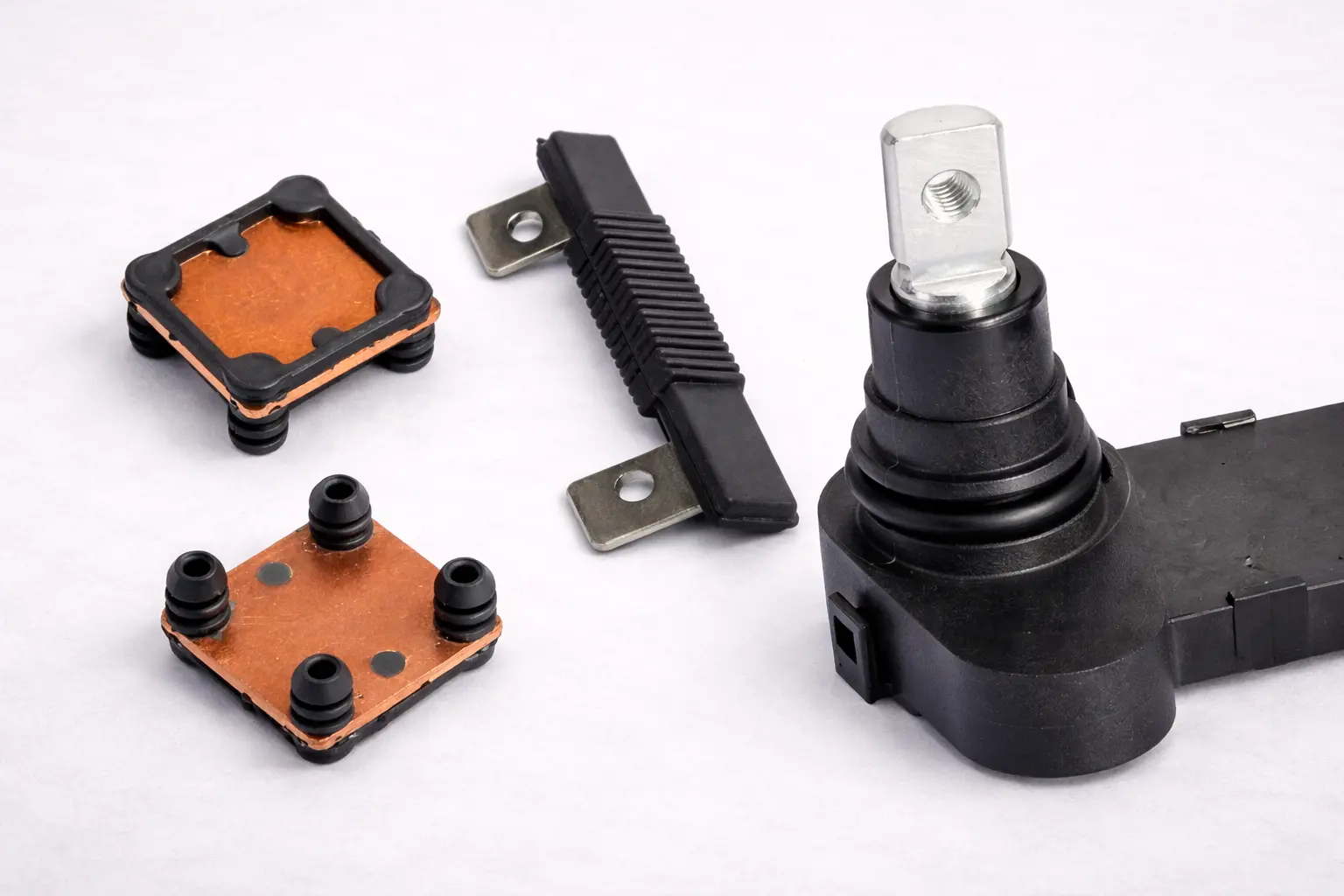
Overmolded Busbars
ARPL manufactures overmolded busbars — copper and aluminum conductors with precision-molded silicone or rubber insulation for electrical isolation, arc flash protection, and environmental sealing. We serve EV battery packs, power distribution units (PDU), inverters, onboard chargers, and industrial switchgear in 400V to 800V+ architectures using HCR silicone, LSR, FR silicone, ceramifiable silicone, EPDM, and Neoprene insulation compounds.
Overmolded Busbar Types
Overmolded Busbars for High-Voltage Insulation & Protection
As EV battery voltages move from 400V to 800V and beyond, robust busbar insulation becomes critical for electrical safety, arc flash prevention, and touch protection. Overmolding applies a seamless, void-free layer of silicone or rubber insulation directly onto the copper or aluminum conductor — providing superior dielectric strength, environmental sealing, and mechanical protection compared to heat shrink, powder coating, or dipped insulation methods.
ARPL uses compression molding, transfer molding, and injection molding to apply insulation onto pre-formed busbars with precise wall thickness control. Our tooling accommodates complex busbar geometries including bends, offsets, multiple connection points, and integrated mounting features — delivering a finished overmolded assembly ready for direct installation into battery modules, PDUs, and inverter housings.
Products We Manufacture
- Fully overmolded busbars — complete silicone or rubber encapsulation of the conductor with exposed terminals for electrical connection
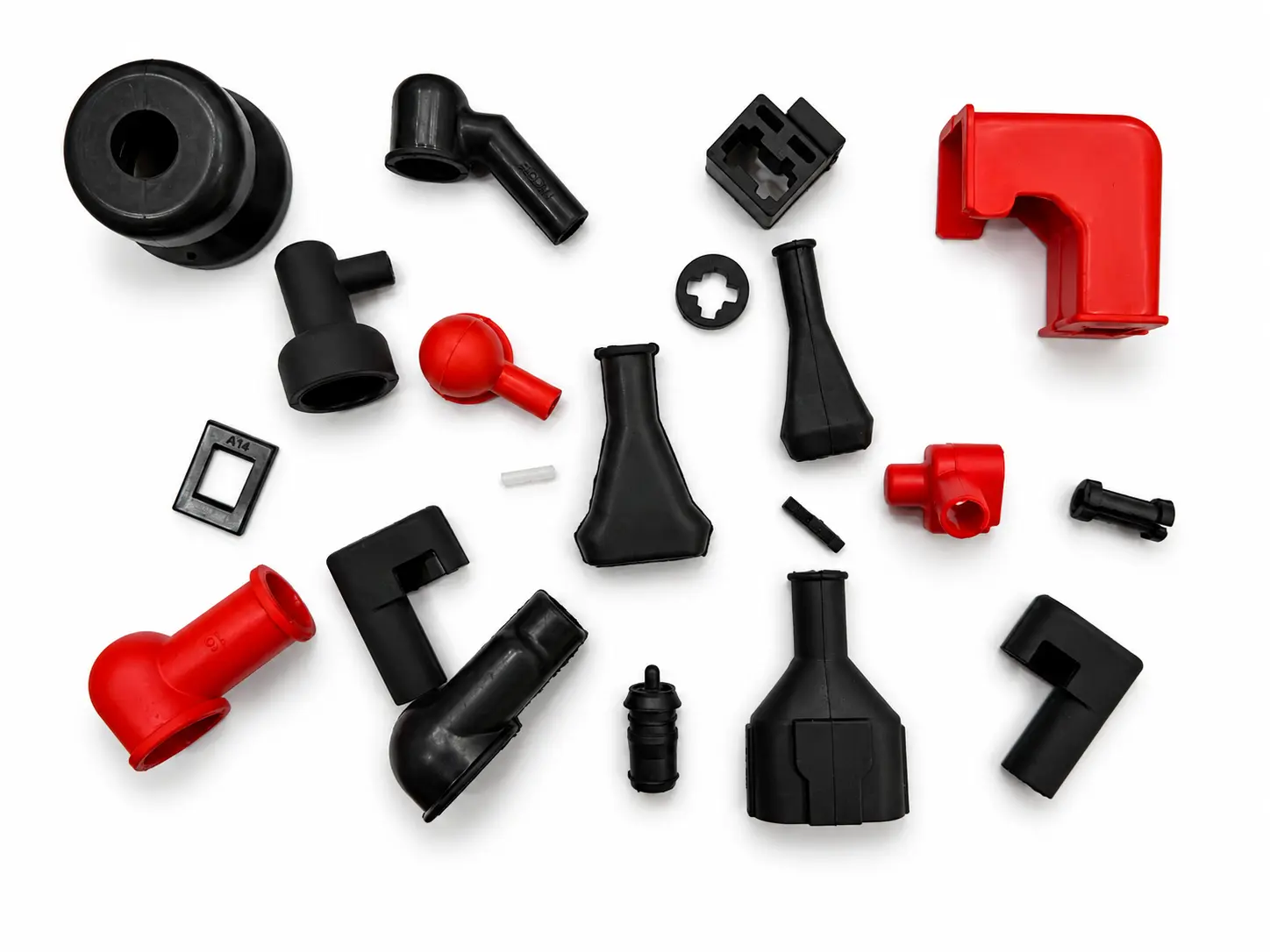
- Insulation boots & covers — snap-fit or molded protective boots for busbar terminals, junction points, and exposed conductors
- Junction & terminal covers — insulating covers for bolted connections, battery terminals, and fuse interfaces
- Insulation sleeves & profiles — extruded or molded silicone sleeves that slide over straight or bent busbar sections
- Busbar seals & gaskets — sealing interfaces where busbars pass through enclosure walls or partition plates
- Custom overmolded assemblies — multi-busbar assemblies with integrated insulation, spacing, and mounting features
Why Choose ARPL for Overmolded Busbars
- ISO 9001:2015 certified — controlled molding processes with dielectric testing and dimensional verification
- In-house tooling — CNC & EDM tool rooms for rapid prototype-to-production mold development
- Multiple molding processes — compression, transfer, and injection molding for optimum insulation quality
- Wide compound range — HCR silicone, LSR, FR silicone, ceramifiable silicone, EPDM, and Neoprene
- Global supply — exporting to USA, Germany, UK, Japan, South Korea, UAE and 15+ countries
- 30+ years experience — established 1993, serving automotive OEMs and Tier-1 suppliers
Insulation Materials & Manufacturing Capabilities
ARPL selects the right insulation compound based on your voltage class, operating temperature, flammability requirements, and environmental exposure. Our molding processes ensure void-free, uniform insulation with controlled wall thickness on complex busbar geometries.
Insulation Material Options
- HCR Silicone / VMQ (-60°C to +200°C) — excellent dielectric strength, flexibility, and wide temperature range. Standard choice for high-voltage busbar insulation in EV applications.
- LSR / Liquid Silicone Rubber (-55°C to +200°C) — injection-moldable for complex geometries and tight tolerances. Ideal for high-volume production with consistent wall thickness.
- FR Silicone (-55°C to +200°C) — flame retardant silicone meeting UL 94 V-0. Self-extinguishing behavior for battery pack and enclosure applications.
- Ceramifiable Silicone (-55°C to +200°C) — forms a rigid ceramic shell at 800-1000°C, maintaining electrical insulation even during fire events. Used for thermal runaway protection on HV busbars.
- EPDM (-50°C to +150°C) — weather and ozone resistant. Cost-effective for medium-voltage industrial switchgear and outdoor applications.
- Neoprene / CR (-35°C to +120°C) — oil and flame resistant. Suited for industrial power distribution with moderate oil exposure.
Key Performance Properties
- Dielectric strength — 15-25 kV/mm depending on compound, ensuring safe insulation for 400V-1000V+ systems
- Flame retardancy — UL 94 V-0 rated FR silicone and ceramifiable grades available
- Tracking resistance — high CTI (Comparative Tracking Index) for leakage current prevention
- Environmental sealing — IP-rated sealing where busbars interface with enclosure walls
- Thermal stability — continuous operation up to +200°C without degradation of insulating properties
Busbar Insulation Material Comparison
| Insulation Material | Temp. Range | Dielectric Strength | Flame Rating | Key Feature | Typical Application |
|---|---|---|---|---|---|
| HCR Silicone | -60 to +200°C | 20-25 kV/mm | HB / V-1 | Standard HV insulation | EV battery busbars, inverter connections |
| LSR | -55 to +200°C | 20-25 kV/mm | HB / V-1 | Complex geometry, tight tolerance | High-volume busbar boots, connector covers |
| FR Silicone | -55 to +200°C | 18-22 kV/mm | V-0 | Self-extinguishing | Battery pack busbars, PDU insulation |
| Ceramifiable | -55 to +200°C | 18-22 kV/mm | V-0 | Forms ceramic at 800°C+ | Thermal runaway busbar protection |
| EPDM | -50 to +150°C | 15-20 kV/mm | HB | Weather/ozone resistant | Industrial switchgear, outdoor panels |
| Neoprene (CR) | -35 to +120°C | 12-18 kV/mm | V-1 | Oil + flame resistant | Industrial power distribution |
Note: Dielectric strength values are typical and depend on compound formulation, insulation thickness, and test conditions. Contact our engineering team for specific validation and design recommendations for your voltage class.
Overmolded Busbar Applications
ARPL's overmolded busbars serve high-voltage and medium-voltage applications in electric vehicles, energy storage, power distribution, and industrial equipment where reliable electrical insulation and conductor protection are essential.
EV Battery Packs & Modules
Battery pack busbars connect cell groups, modules, and pack-level power distribution in 400V and 800V architectures. Overmolded insulation provides dielectric isolation between closely spaced conductors, touch protection during assembly and service, and environmental sealing where busbars pass through partition walls. Ceramifiable silicone insulation offers an additional safety layer — forming a rigid ceramic barrier during thermal runaway events to prevent busbar short circuits.
Power Distribution Units (PDU) & Inverters
PDU busbars route power between battery pack, inverter, onboard charger, DC-DC converter, and auxiliary systems. Overmolded insulation enables compact busbar routing with reduced creepage and clearance distances, supporting higher power density in constrained packaging. ARPL supplies overmolded busbars and terminal covers for PDU and inverter housings with FR silicone and LSR insulation.
EV Chargers & Energy Storage
AC and DC charging stations use busbars for internal power distribution between rectifier stages, contactors, and output connectors. Battery energy storage systems (BESS) require insulated busbars for cell interconnection and rack-level power distribution. ARPL supplies overmolded busbars with flame-retardant insulation rated for continuous high-current operation in charging and storage environments.
Industrial Switchgear & Power Distribution
Medium-voltage switchgear panels, motor control centers, and power distribution boards use insulated busbars for conductor protection, arc flash mitigation, and environmental sealing. ARPL supplies EPDM and Neoprene overmolded busbars for industrial applications with compound selection matched to the operating voltage, temperature, and chemical environment.
Global Export Markets
ARPL exports overmolded busbars from India to OEMs and Tier-1 suppliers in the USA, Germany, UK, France, Italy, Japan, South Korea, Taiwan, UAE, Saudi Arabia, Turkey, Canada, Mexico, and Sweden. All exports comply with REACH, RoHS, and destination country regulations.
Request a Quote
Get a custom quote for your overmolded busbar requirements
Related Products

Frequently Asked Questions
Find answers to common questions about overmolded busbars
Overmolded busbars are copper or aluminum conductors with a precision-molded layer of silicone or rubber insulation applied directly onto the busbar surface. The overmolding process creates a seamless, void-free insulation envelope that provides electrical isolation, arc flash protection, touch safety, and environmental sealing for high-voltage power distribution in EV battery packs, inverters, PDUs, and industrial equipment.
ARPL uses HCR Silicone (VMQ) for standard HV insulation, LSR for complex geometries and high-volume production, FR Silicone for UL 94 V-0 compliance, ceramifiable silicone for thermal runaway busbar protection, EPDM for weather-resistant industrial applications, and Neoprene for oil-resistant environments. Material selection is based on voltage class, temperature, flammability, and chemical exposure.
Silicone and rubber insulation compounds have dielectric strengths of 15-25 kV/mm. With appropriate insulation wall thickness, overmolded busbars can be designed for 400V, 800V, and 1000V+ system voltages with adequate creepage and clearance. ARPL works with your voltage, creepage, and dielectric withstand requirements to determine the right compound and wall thickness.
Ceramifiable silicone is a special compound that transforms into a rigid, electrically insulating ceramic shell when exposed to extreme heat (800-1000°C). In a battery thermal runaway event, the ceramic layer maintains busbar insulation and prevents short circuits even after the organic rubber has been consumed. This provides an additional safety layer beyond standard flame-retardant insulation.
Yes. ARPL can overmold insulation onto customer-supplied pre-formed copper or aluminum busbars. We can also manufacture the complete overmolded assembly — from busbar forming through insulation molding — using our in-house CNC tooling and compression/transfer/injection molding capabilities. Both approaches are supported from prototype through series production.
Overmolding provides superior insulation uniformity, higher dielectric strength, better environmental sealing, and greater mechanical protection compared to heat shrink tubing or powder coating. Overmolded insulation is void-free with controlled wall thickness, conforms precisely to complex busbar geometries, and can incorporate integrated sealing features — eliminating the variability inherent in secondary insulation processes.
Please share: busbar drawing or 3D model, conductor material (copper or aluminum), system voltage and dielectric withstand requirement, insulation material preference, flammability rating target (e.g. UL 94 V-0), operating temperature range, exposed terminal areas, annual volume, and any PPAP or validation requirements.
Yes. ARPL exports overmolded busbars globally to USA, Germany, UK, France, Italy, Japan, South Korea, Taiwan, UAE, Saudi Arabia, Turkey, Canada, Mexico, Sweden, and Netherlands. All exports comply with REACH, RoHS, and destination country regulations.