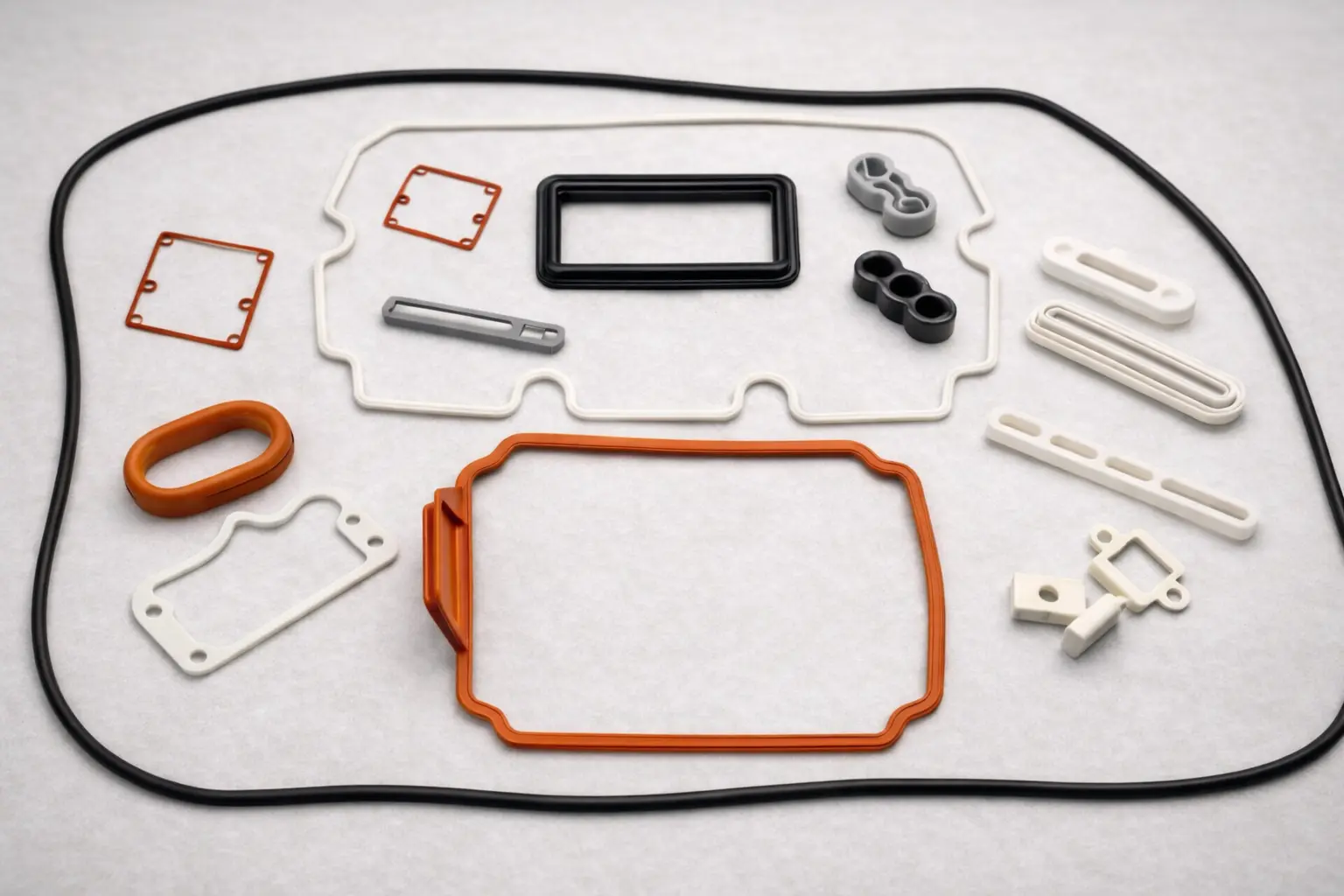
EV Battery Seals
EV battery seals and battery pack gaskets are elastomeric sealing components used to protect electric vehicle and energy storage enclosures from water, dust, road splash, and chemical exposure. Installed in a precision groove between the battery cover and tray (or in sub-assemblies like junction boxes and service panels), these seals maintain controlled compression, resist long-term compression set, and support ingress protection targets such as IP67/IP68. Material selection is guided by service temperature, media exposure (coolant, salt spray, oils), and the enclosure’s clamping design.
Available Battery Seal Materials
We manufacture battery seals and battery pack gaskets in the above materials with custom hardness options and compounds tailored to IP, temperature cycling, and media resistance requirements.
About ARPL EV Battery Seals
ARPL designs and manufactures EV battery seals and battery pack gaskets for reliable enclosure sealing in electric vehicles, hybrid systems, and stationary energy storage. These seals help protect battery modules and power electronics from water and dust ingress, minimize corrosion risk, and maintain consistent sealing performance through vibration and temperature cycling.
We produce custom molded seals and gaskets based on drawings, grooves, or samples, with tight dimensional control and compound selection tailored to your performance targets. Depending on your enclosure design, our engineering team can recommend materials and hardness to balance low compression set, chemical resistance (coolants, road salts, oils), and long-term durability.
Why Choose ARPL for Battery Pack Sealing?
With over 30 years of manufacturing expertise, ARPL supports both prototyping and high-volume production for OEMs and Tier-1 suppliers. Our battery sealing solutions are developed for high reliability, consistent compression, and stable performance in outdoor environments. Whether you require a perimeter battery pack gasket, junction box seals, service panel gaskets, or specialized battery vent/terminal seals, we can deliver repeatable quality at scale.
Material Selection Guide
Selecting the right elastomer is critical for EV battery sealing performance, especially across temperature cycling and long-term compression. Below is a practical guide to common materials used for battery seals and gaskets:
| Material | Temperature Range | Key Properties | Typical Battery Applications |
|---|---|---|---|
| EPDM (Solid / Sponge) | -50°C to +150°C | Excellent weather/ozone resistance, good for outdoor sealing, good compression set options | Battery enclosure perimeter seals, serviceable cover gaskets, outdoor ESS housings |
| Silicone (VMQ) | -60°C to +200°C | Wide temperature range, good flexibility, low compression set, available in sponge/foam grades | IP-rated enclosure gaskets, charging equipment seals, electronics/busbar covers |
| Fluorosilicone (FVMQ) | -55°C to +200°C | Silicone temperature performance with improved fuel/solvent resistance | Areas with hydrocarbon exposure, specialized battery connector/terminal sealing |
| FKM (Viton®) | -20°C to +200°C | High chemical resistance, good high-temperature stability | Chemically aggressive environments, select coolant/chemical exposure areas |
| HNBR | -30°C to +150°C | Improved heat and oil resistance, good mechanical strength | Auxiliary systems, interfaces exposed to oils/greases, robust molded seals |
| NBR (Nitrile) | -40°C to +120°C | Cost-effective, good oil resistance, good mechanical properties | General industrial battery enclosures and ancillary components (application dependent) |
EV Battery Seal Applications
ARPL battery seals are engineered for sealing critical interfaces in EV and energy storage systems where ingress protection and long-term durability are required.
- Battery pack enclosure perimeter seals (cover-to-tray gaskets)
- Battery junction box & HV distribution seals
- Service panel and access cover gaskets
- Cooling plate and coolant manifold sealing interfaces
- Battery terminal & connector interface sealing
- Outdoor ESS enclosures (dust/rain/UV exposure)
- Charging equipment and power electronics enclosures
Share your drawing or groove details along with IP target, temperature range, and media exposure—our team will recommend the best material and gasket geometry for your design.
Request a Quote
Get a custom quote for your O-Ring requirements
Related Products

Frequently Asked Questions
Find answers to common questions about EV battery seals and battery pack gaskets
EV battery seals and battery pack gaskets are elastomeric sealing components installed between mating surfaces of a battery enclosure (cover-to-tray, access panels, junction boxes). They help prevent water and dust ingress, reduce corrosion risk, and protect sensitive battery and electronics components.
EPDM is widely used for outdoor durability (UV/ozone/weathering). Silicone (VMQ) is used for wide temperature performance and low compression set, including foam/sponge grades. Fluorosilicone (FVMQ) improves resistance to fuels/solvents, while FKM (Viton®) is selected for higher chemical resistance. HNBR/NBR are used for specific fluid environments and mechanical robustness.
Yes. Battery sealing systems are designed to help enclosures meet ingress protection targets such as IP67/IP68. The final IP rating depends on the complete enclosure design—gasket geometry, compression, surface finish, fastener pattern, vents and assembly process.
Yes. ARPL develops custom molded seals and gaskets based on 2D/3D drawings, groove details, or samples. We support prototyping, tooling development, compound selection, and high-volume production with controlled tolerances.
Share the sealing location (cover-to-tray, junction box, connector), drawing or groove dimensions, target IP level, operating temperature, media exposure (coolant, road salts, oils), compression/clamping details, expected annual volume, and any standards or test requirements. This lets us recommend the right compound and gasket geometry.
Yes. ARPL supplies sealing components for EV battery enclosures as well as ESS housings and power electronics enclosures. We can tailor compounds for outdoor durability, temperature cycling, and long-term compression set performance.
An EV battery seal is an elastomeric component installed in a groove between a battery enclosure's cover and tray, and in sub-assemblies like junction boxes and service panels, to block water, dust, and chemical ingress and support IP67/IP68 protection.
Depending on compound, ARPL EV battery seals operate from roughly -60°C to +200°C — silicone (VMQ) for the widest range, EPDM for outdoor weathering, FVMQ and FKM for chemical exposure, and HNBR or NBR for oil resistance.
Yes. ARPL is an ISO 9001:2015 certified manufacturer based in IMT Manesar, Gurugram, supplying EV battery seals from prototype to high-volume production with global supply capability.