O-rings represent one of the most deceptively simple yet critically important components in modern engineering. These circular elastomeric seals—typically just millimeters in cross-section—prevent fluid leaks, maintain pressure boundaries, and ensure operational reliability across millions of automotive, aerospace, and industrial systems worldwide.
Despite their modest appearance, o-rings operate in environments where failure carries significant consequences. A single compromised seal in an automotive coolant assembly can trigger engine overheating. A degraded o-ring in hydraulic braking systems jeopardizes vehicle safety. An improperly manufactured seal in industrial processing equipment may halt production lines worth thousands per hour.
Manufacturing excellence in o-ring production demands more than simply molding rubber into circular shapes. It requires precise material selection aligned with operating conditions, controlled manufacturing processes that ensure dimensional repeatability, rigorous surface finishing to eliminate leak paths, and comprehensive testing protocols that validate performance before deployment.
At ARPL, we've refined our rubber O-rings manufacturing over three decades, developing systematic approaches that transform raw elastomers into precision sealing components. This article examines the engineering disciplines, process controls, and quality systems that underpin reliable o-ring performance.
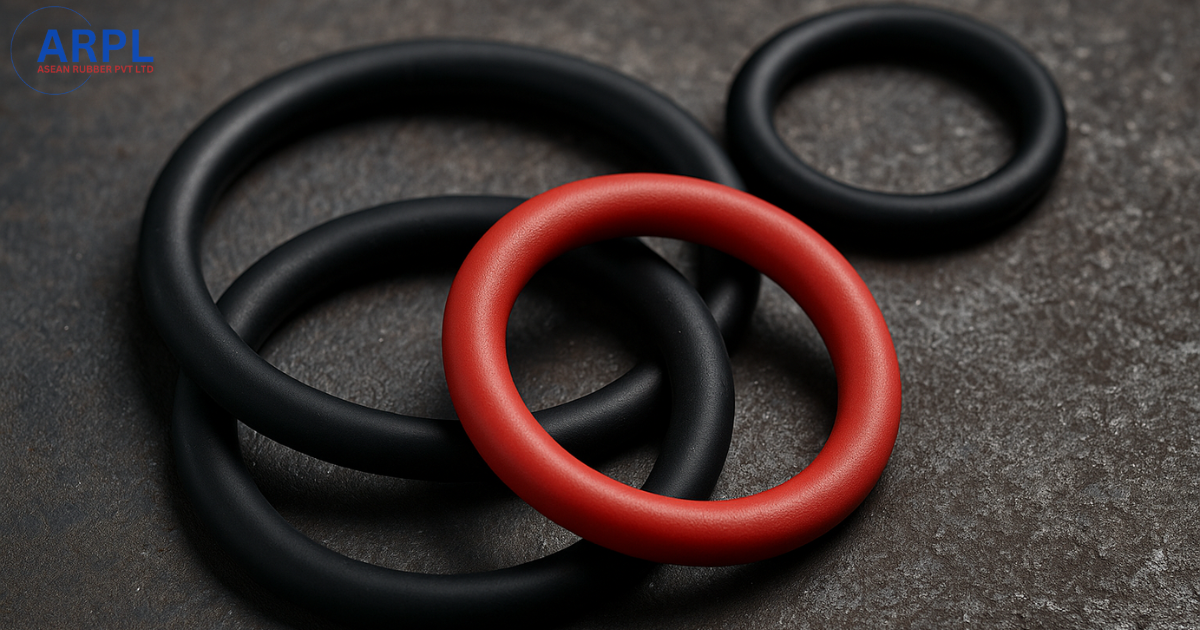
Material Selection: Matching Elastomer Properties to Application Requirements
The foundation of o-ring performance begins with selecting the appropriate elastomer compound. Unlike metal components where material properties remain relatively stable, elastomers exhibit dramatically different behaviors depending on their chemical composition and the environments they encounter.
Choosing the correct material requires understanding both the o-ring's immediate operating conditions and its long-term exposure profile. Temperature extremes, chemical compatibility, mechanical stress cycles, and environmental factors all influence material selection. This decision becomes even more critical as automotive and industrial systems push toward higher temperatures, extended service intervals, and more aggressive chemical exposures.
NBR (Nitrile): The Workhorse for Fuel and Oil Resistance
Nitrile rubber remains the most widely specified elastomer for automotive sealing components exposed to petroleum-based fluids. Its molecular structure provides excellent resistance to mineral oils, gasoline, diesel fuel, and hydraulic fluids—the very substances that rapidly degrade natural rubber or certain synthetic alternatives.
NBR o-rings find extensive application in fuel system connectors, transmission assemblies, and power steering components where consistent sealing against hydrocarbon exposure is essential. The material maintains acceptable flexibility across moderate temperature ranges while offering good mechanical properties and cost-effectiveness that makes it suitable for high-volume automotive production.
However, NBR exhibits limitations that must be understood during material selection. Its performance degrades when exposed to ozone, strong acids, and aromatic hydrocarbons. Temperature capability remains restricted compared to more advanced elastomers. These constraints require engineers to carefully evaluate whether NBR meets the specific demands of each sealing application.
EPDM: Weather Resistance and Coolant System Excellence
Ethylene Propylene Diene Monomer (EPDM) dominates applications requiring resistance to water-based coolants, steam, weathering, and ozone exposure. Its saturated polymer backbone provides inherent resistance to oxidative degradation that makes it ideal for outdoor exposure and cooling system applications.
EPDM o-rings excel in automotive coolant systems, radiator assemblies, and environmental sealing applications where sunlight, ozone, and temperature cycling challenge seal integrity. The material maintains excellent flexibility at low temperatures while resisting the glycol-based coolants used throughout the automotive industry.
The trade-off with EPDM appears in its limited resistance to petroleum-based fluids. Where NBR thrives against mineral oils, EPDM swells and degrades. This complementary characteristic between NBR and EPDM drives material selection decisions across automotive platforms—NBR for fuel and oil systems, EPDM for coolant and environmental sealing.
Silicone (HTV): Extreme Temperature Flexibility for EV Applications
High-Temperature Vulcanized (HTV) silicone offers temperature capabilities that exceed conventional hydrocarbon elastomers. Maintaining flexibility from -60°C to +200°C, silicone addresses applications where extreme thermal cycling would cause competing materials to harden, crack, or lose sealing force.
The electric vehicle revolution amplifies silicone's importance. Battery thermal management systems, power electronics cooling circuits, and charging port seals demand materials that withstand both the heat generated by high-power electrical systems and the cold-weather exposure inherent to automotive service. Silicone's biocompatibility and chemical inertness additionally make it valuable in medical device and pharmaceutical applications.
Despite superior temperature performance, silicone exhibits lower mechanical strength and tear resistance compared to NBR or EPDM. Applications requiring high durometer hardness or resistance to mechanical abrasion may require alternative materials. Understanding these performance trade-offs ensures appropriate material deployment.
FKM (Viton): Premium Performance for Extreme Chemical and Thermal Environments
Fluorocarbon elastomers (FKM, commonly known by the brand name Viton) represent the premium tier of o-ring materials. Combining exceptional chemical resistance with sustained performance at temperatures approaching 250°C, FKM enables sealing in environments that destroy lesser materials.
Viton o-rings find application in turbocharged engine systems, aggressive industrial chemicals, petroleum refining equipment, and aerospace hydraulics. The material resists virtually all automotive fluids including gasoline, diesel, transmission fluid, and motor oil while maintaining sealing performance through thousands of thermal cycles.
The engineering advantages of FKM come with higher material costs that necessitate careful application assessment. Where NBR or EPDM adequately meet performance requirements, specifying FKM adds unnecessary expense. However, in demanding environments where seal failure carries severe consequences or replacement costs exceed material premiums, FKM delivers exceptional value through extended service life and operational reliability.
Selecting among these elastomers—or considering specialty compounds including fluoro-silicone, perfluoroelastomers, or custom formulations—requires comprehensive understanding of operating conditions. Our approach to rubber compound selection emphasizes matching material properties to real-world performance requirements rather than defaulting to familiar materials without proper evaluation.
ARPL's O-Ring Manufacturing Workflow: From Raw Material to Finished Component
Consistent o-ring performance depends on controlled manufacturing processes that ensure repeatability across production batches. Our manufacturing workflow implements systematic controls at each process stage, transforming raw elastomers into precision sealing components through disciplined processing.
CMB to FMB: Precision Material Batching
O-ring manufacturer India operations begin with converting raw polymer (CMB—Continuous Mix Batch) into finished compound (FMB—Final Mix Batch) through careful mixing of base elastomer, curing agents, fillers, processing aids, and performance additives. This compounding stage determines fundamental material properties including hardness, tensile strength, compression set resistance, and chemical compatibility.
Our batching process employs precise weighing systems and controlled mixing parameters that ensure compound consistency. Each FMB batch undergoes rheometer testing to verify cure characteristics before release to production, preventing variability that could compromise molded component properties.
Preforming and Weight Precision
Compression molding requires accurately sized material charges that fill mold cavities completely without excess flash or material shortage. We employ automated preforming systems that cut compound to precise weights based on o-ring dimensions and material density.
Weight precision directly influences dimensional accuracy. Insufficient material produces undersized o-rings with inadequate cross-sectional diameter. Excess material generates heavy flash that complicates deflashing and risks dimensional variation. Maintaining preform weight within ±2% tolerances ensures consistent cavity filling across production runs.
Compression Molding: ARPL's Core Manufacturing Specialization
Unlike extrusion processes that produce o-rings by cutting continuous rubber tubes, compression molding forms each o-ring individually within precision-machined cavities. This manufacturing method delivers superior dimensional control, eliminates the parting line weakness inherent to extruded o-rings, and enables economical production of small to medium batch quantities.
Our compression molding operations utilize modern hydraulic presses equipped with programmable pressure and temperature controls. Multi-cavity molds enable efficient production while maintaining the individual cavity precision necessary for tight tolerances. Each mold undergoes regular dimensional verification to ensure continued conformance to engineering specifications.
Curing Cycle Control
The vulcanization process transforms plastic rubber compound into an elastic, resilient o-ring through controlled crosslinking of polymer chains. Cure temperature, pressure, and time must be precisely balanced—insufficient cure leaves compounds weak and prone to compression set, while over-cure produces brittle components with poor flexibility.
We establish cure parameters through systematic rheometer testing that identifies optimum vulcanization conditions for each compound formulation. Process controllers maintain temperature within ±2°C and timing within ±5 seconds, ensuring consistent crosslink density across production batches. This attention to curing parameters directly translates to predictable o-ring performance and extended service life.
Mold Maintenance and Cavity Repeatability
Dimensional precision depends not only on process control but on maintaining tooling accuracy throughout production life. Compression molded o-rings cavities experience thermal cycling, mechanical wear, and potential compound residue buildup that can affect component dimensions.
Our preventive maintenance program includes regular mold cleaning, dimensional inspection, and surface treatment to preserve cavity specifications. When dimensional verification reveals cavity wear approaching tolerance limits, we implement mold refurbishment or replacement before out-of-specification components reach customers. This proactive approach ensures dimensional consistency across thousands of molding cycles.
Surface Finish Excellence Through Cryogenic Deflashing
The compression molding process inherently generates flash—thin rubber material that flows into parting line gaps between mold halves. While unavoidable, flash must be removed to achieve the smooth, uniform sealing surfaces essential for reliable o-ring performance.
The Cryogenic Deflashing Advantage
Traditional manual deflashing relies on operators tumbling molded o-rings with abrasive media or manually trimming flash with cutting tools. These methods introduce variability in surface finish, risk damaging sealing surfaces, and prove labor-intensive for high-volume production.
Cryogenic deflashing addresses these limitations through a controlled process that leverages material property changes at extremely low temperatures. Molded o-rings are exposed to liquid nitrogen or similarly cold environments where flash becomes brittle while the bulk o-ring material maintains flexibility. Subsequent tumbling in a rotating drum causes flash to fracture and separate cleanly without damaging the component's sealing surfaces.
This approach delivers consistently burr-free o-rings with uniform surface quality across entire production batches. The automated nature of cryogenic deflashing eliminates operator variability while improving throughput for high-volume operations.
Why Surface Quality Matters for Sealing Performance
O-ring sealing depends on achieving intimate contact between the elastomeric surface and the mating hardware. Even microscopic irregularities—residual flash, rough surfaces, or dimensional inconsistencies—create potential leak paths that compromise seal integrity.
Cryogenic deflashing produces o-rings with smooth, consistent surfaces that establish reliable sealing interfaces. This surface uniformity becomes particularly critical in dynamic applications where o-rings experience reciprocating or rotary motion. Rough surfaces accelerate wear, generate heat, and potentially create leak paths as components age.
By implementing cryogenic deflashing across our product lines, we ensure that surface finish quality matches the dimensional precision of our molding operations. This comprehensive approach to manufacturing excellence extends beyond simply producing correctly sized o-rings to delivering components optimized for reliable field performance.
Dimensional Precision and Tolerance Control
O-ring functionality depends critically on maintaining dimensional specifications within defined tolerances. Cross-sectional diameter determines squeeze characteristics, inside diameter affects installation and sealing force, and surface finish influences leak resistance. Deviation from specified dimensions compromises sealing performance.
Achieving ±0.05 mm Tolerances Through Process Control
Our manufacturing systems routinely achieve tolerances as tight as ±0.05 mm on critical o-ring dimensions through systematic control of every process variable affecting final component geometry. This capability enables production of o-rings for demanding applications where dimensional precision directly determines performance.
Several interconnected systems contribute to this dimensional control. Tooling Precision: Mold cavities are machined to specifications that account for material shrinkage during cooling. Regular dimensional verification ensures continued conformance as tooling experiences production wear. When cavity dimensions drift toward tolerance limits, we implement corrective action before producing non-conforming components.
Consistent Molding Pressure: Hydraulic press controls maintain cavity pressure within narrow bands that ensure complete material flow without excessive flash generation. Pressure consistency across multiple cavities in multi-cavity molds prevents dimensional variation between simultaneously molded components.
Batch Traceability: Every production lot receives unique identification enabling traceability from finished o-ring back through molding parameters, compound batch, and raw material lots. This traceability facilitates rapid root cause analysis if dimensional issues emerge and enables targeted corrective action.
Process Documentation: Detailed process specifications define every parameter affecting o-ring dimensions—preform weight, cure time and temperature, cooling time, and deflashing parameters. Operators follow documented procedures that eliminate variation from individual interpretation or experience levels.
Statistical Process Control for Continuous Improvement
Maintaining tight tolerances requires not only capable processes but continuous monitoring that detects trends before they produce non-conforming parts. We employ statistical process control techniques that track key dimensions across production runs, identifying patterns that may indicate emerging issues.
Control charts, capability studies, and trend analysis enable proactive process adjustments that maintain dimensional consistency. Rather than simply inspecting finished components and sorting conforming from non-conforming parts, this approach prevents defects through early intervention when process drift appears.
Quality Control and Testing: Validating Performance Before Deployment
Manufacturing excellence extends beyond process control to include comprehensive testing that validates o-ring properties meet specification requirements. Our quality systems implement multiple inspection and testing stages that verify material properties, dimensional accuracy, and functional performance.
Shore A Hardness Testing
Hardness measurement provides rapid assessment of material properties and cure state. Every production batch undergoes Shore A durometer testing that confirms hardness falls within specified ranges. Deviations may indicate compounding errors, cure parameter variations, or aging issues that require investigation.
Hardness directly influences o-ring sealing behavior. Softer compounds conform more readily to mating surfaces but exhibit reduced resistance to extrusion. Harder materials provide better extrusion resistance but require higher sealing forces. Maintaining hardness within specification ensures predictable sealing performance.
Tensile Strength and Elongation Measurement
Mechanical property testing evaluates material strength and flexibility through standardized tensile tests. Die-cut specimens undergo controlled stretching until failure while instruments record stress and strain. These measurements verify that compounding and curing processes produced material properties matching design requirements.
Tensile properties particularly matter for o-rings experiencing installation stress or dynamic movement. Insufficient tensile strength risks o-ring failure during assembly. Inadequate elongation may cause tearing when o-rings stretch over components during installation. Testing these properties before shipping prevents field failures from material deficiencies.
Compression Set Testing: Predicting Long-Term Sealing
Perhaps the most critical material property for o-ring performance is compression set resistance—the material's ability to recover its original shape after sustained compression. O-rings function by being compressed between surfaces; loss of recovery over time reduces sealing force and enables leak paths.
Compression set testing involves compressing material specimens at elevated temperature for defined periods, then measuring thickness recovery after load removal. Low compression set values indicate good recovery and predict sustained sealing over years of service. High compression set suggests premature seal failure as o-rings permanently deform under load.
We perform compression set testing on all new compound formulations and periodically on production batches to verify continued material performance. This testing provides objective evidence that our compression molded o-rings will maintain sealing force throughout their intended service life.
Visual Inspection for Surface Quality
Automated and manual visual inspection systems examine o-ring surfaces for flash residue, surface blemishes, contamination, or molding defects that could compromise sealing. High-magnification inspection identifies issues invisible to casual observation but potentially significant for demanding applications.
Surface inspection becomes particularly critical for components destined for hydraulic systems, aerospace applications, or medical devices where even minor surface irregularities may create leak paths or particle generation. Our multi-stage inspection process ensures only conforming components reach customers.
Applications: Where Precision O-Rings Make the Difference
The manufacturing disciplines described above enable ARPL to supply precision o-rings across diverse applications where sealing reliability directly impacts system performance, safety, and operational efficiency.
Automotive Coolant and Fuel Assemblies
Modern automotive powertrains demand sealing components that withstand aggressive coolants, fuel system pressures, and thermal cycling from -40°C to +150°C. Our o-rings provide reliable sealing in connector assemblies, fuel rail systems, thermostat housings, and coolant distribution modules that must function flawlessly over years and hundreds of thousands of kilometers.
Electric Vehicle Systems
The electrification transition introduces new sealing challenges as battery thermal management systems, inverter cooling circuits, and charging infrastructure require materials compatible with specialized coolants and capable of extended temperature ranges. Silicone and fluorosilicone o-rings address these emerging requirements while maintaining the precision and reliability automotive systems demand.
Hydraulic and Pneumatic Sealing
Industrial hydraulic systems operating at thousands of PSI pressure depend on o-rings that resist extrusion while maintaining leak-free sealing across millions of pressure cycles. Our precision manufacturing and material expertise deliver o-rings optimized for these demanding applications where seal failure halts production lines and risks equipment damage.
Industrial Plant Equipment
Chemical processing, pharmaceutical manufacturing, and food production facilities require sealing components meeting stringent regulatory requirements while withstanding process chemicals, elevated temperatures, and rigorous cleaning protocols. Material selection expertise and controlled manufacturing enable us to supply o-rings that balance chemical compatibility, regulatory compliance, and operational reliability.
Sealing Reliability Is Engineered, Not Accidental
O-rings may appear simple, but reliable sealing performance emerges only through systematic engineering—matching materials to applications, controlling manufacturing processes to ensure dimensional precision, implementing surface finishing techniques that optimize sealing surfaces, and validating properties through comprehensive testing.
At ARPL, three decades of manufacturing experience has taught us that excellence in o-ring production requires attention to details that less disciplined manufacturers overlook. From compound formulation chemistry through final inspection, every process step receives the engineering rigor necessary to produce components that perform reliably in demanding applications.
Our commitment extends beyond simply making o-rings to developing manufacturing systems that ensure consistency, implementing quality controls that verify performance, and maintaining the technical expertise necessary to support customers with application-specific sealing challenges.
Whether your application demands high-volume production of standard sizes or custom-engineered solutions for unique sealing requirements, our manufacturing infrastructure and technical capabilities deliver the precision, quality, and reliability that critical sealing applications require.
Frequently Asked Questions About O-Ring Manufacturing
What materials are used for o-ring manufacturing?
O-rings are manufactured using various elastomers, each selected for specific performance characteristics. NBR (Nitrile) provides excellent fuel and oil resistance for automotive powertrain applications. EPDM offers superior weather resistance and coolant compatibility for cooling systems and environmental sealing. Silicone (HTV) delivers extreme temperature flexibility from -60°C to +200°C, making it ideal for EV battery cooling and high-temperature applications. FKM (Viton) provides premium chemical resistance and high-temperature performance up to 250°C for demanding industrial environments. Material selection depends on application requirements including temperature range, chemical exposure, mechanical stress, and cost constraints.
How does ARPL ensure o-ring dimensional precision?
ARPL maintains o-ring dimensional precision through multiple integrated quality systems. Our precision-machined tooling accounts for material shrinkage during cooling, while hydraulic press controls maintain cavity pressure within narrow tolerances ensuring complete material flow. We implement comprehensive batch traceability that tracks each production lot from raw materials through molding parameters to finished components. Detailed process documentation defines every parameter affecting dimensions including preform weight, cure time and temperature, cooling time, and deflashing parameters. Statistical process control techniques monitor key dimensions across production runs, enabling proactive adjustments before any drift produces non-conforming parts. This systematic approach routinely achieves tolerances as tight as ±0.05 mm on critical o-ring dimensions.
What is cryogenic deflashing and why is it important?
Cryogenic deflashing is a precision finishing process that removes flash from molded o-rings by exposing them to extremely low temperatures (typically using liquid nitrogen). At these temperatures, flash becomes brittle while the bulk o-ring material maintains flexibility. Subsequent tumbling in a rotating drum causes the brittle flash to fracture and separate cleanly without damaging the component's critical sealing surfaces. This automated process delivers consistently burr-free o-rings with uniform surface quality across entire production batches, eliminating the variability and potential surface damage associated with manual deflashing methods. Surface quality directly impacts sealing performance—even microscopic irregularities can create leak paths that compromise seal integrity, making cryogenic deflashing essential for reliable field performance.
What quality tests are performed on o-rings before shipping?
ARPL implements comprehensive testing protocols to validate o-ring performance before deployment. Shore A hardness testing confirms material cure state and consistency, ensuring predictable sealing behavior. Tensile strength and elongation measurement verifies mechanical properties meet design requirements and prevents failures during installation or dynamic service. Compression set testing—perhaps the most critical property—evaluates the material's ability to recover after sustained compression, predicting long-term sealing performance over years of service. Visual inspection systems examine surfaces for flash residue, blemishes, contamination, or molding defects using both automated and manual high-magnification inspection. Additionally, dimensional verification ensures all critical measurements fall within specified tolerances. This multi-stage testing approach guarantees only conforming components reach customers.
Why choose compression molding over other o-ring manufacturing methods?
Compression molding offers several distinct advantages for o-ring production compared to extrusion or other manufacturing methods. This process forms each o-ring individually within precision-machined cavities, delivering superior dimensional control compared to cutting extruded tubes. Compression-molded o-rings eliminate the parting line weakness inherent to extruded o-rings that are joined after cutting, providing uniform strength throughout the entire cross-section. The method enables economical production of small to medium batch quantities without the tooling investment required for transfer or injection molding. Multi-cavity molds allow efficient production while maintaining individual cavity precision necessary for tight tolerances. Additionally, compression molding accommodates a wide range of elastomer compounds including those with poor flow characteristics that challenge other molding methods. For applications demanding dimensional precision, mechanical integrity, and manufacturing flexibility, compression molding represents the optimal production approach.
How do I select the right o-ring material for my application?
Selecting the optimal o-ring material requires systematic analysis of your application's operating conditions and performance requirements. Begin by identifying the temperature range—both continuous operating temperature and thermal cycling extremes. Document all chemical exposures including fluids, gases, cleaning agents, and environmental factors like ozone or UV radiation. Assess mechanical requirements including compression force, dynamic movement (static vs. reciprocating vs. rotary), and abrasion resistance needs. Consider regulatory compliance requirements for industries like food processing, pharmaceuticals, or medical devices. Evaluate service life expectations and maintenance intervals that impact material selection and cost justification. Finally, balance performance requirements against commercial constraints including material cost, supply chain stability, and production volumes. ARPL's technical team can assist with material selection analysis, providing compound recommendations based on your specific application parameters and conducting compatibility testing when needed to validate performance before full production commitment.
Need Precision O-Rings for Your Application?
ARPL's three decades of manufacturing excellence ensures your sealing components meet the highest standards of quality, precision, and performance.
Request Engineering Support